Desk Work, Neck Tension and Headaches: The Muscles Behind It
Hours at a desk or on a phone keep a few neck and shoulder muscles working with little rest. They can develop trigger points, tight spots that send pain up into the head. That is why a stiff neck and a headache so often arrive together after a long workday, and why small desk changes are worth making.
Learn moreHow Dr. Gordon treats neck painWhat hours at a screen ask of your neck
At a screen, your head drifts forward and your shoulders creep up. A phone tips the head further still. That is harmless for a few minutes. The trouble is holding it for hours, often under deadline stress.
A handful of muscles carry most of that load:
- Upper trapezius, from the base of the skull to the top of the shoulder. It tightens when your shoulders creep up as you type.
- Levator scapulae, from the side of the neck to the shoulder blade. It works hard when you lean toward a screen.
- Suboccipitals, small muscles just under the base of the skull that fine-tune how your head sits.
- Sternocleidomastoid, the long muscle along the front and side of the neck.
The National Institute of Neurological Disorders and Stroke lists postures that strain the head or neck, such as working on a computer or staring at a phone, among the triggers for tension-type headache. A review of office worker studies linked long stretches of the same task, and a feeling of muscle tension, with new neck pain.
How a tight neck turns into a headache
A trigger point is a tight, tender spot in a band of muscle. Pressing it often brings on pain somewhere else, called referred pain. Trigger points in the upper trapezius, suboccipitals and sternocleidomastoid can refer pain into the head, around the eyes and into the face.
Tension-type headache is the most common kind of headache. It feels like steady pressure or a band around the head. Stress can make the muscles of the neck, face, scalp and jaw tighten, which is part of why it builds on long days. In one study of people with chronic tension-type headache, pain referred from active trigger points in the head and neck muscles matched their usual headache pattern.
Cervicogenic headache starts in the neck and spreads up over the head. It is pain referred from structures such as the upper neck joints. Nerves from the top of the neck feed into the same pain relay center as nerves from the head, so the brain can read a neck problem as head pain. It is much less common than tension-type headache.
Migraine is a different condition, but stress and poor sleep lower the headache threshold, and jaw clenching often adds to the load. The headaches and migraines page explains each type.
Simple desk changes that help
From the NIH's workstation guidance:
- Put the screen about an arm's length away, roughly 20 to 26 inches, with the top at eye level when you sit upright.
- Bring the keyboard close, at a height that lets your shoulders relax and your arms rest at your sides.
- Set armrests so you can drop your shoulders.
- Do not stay in one position for long. Alternate sitting and standing when you can.
Two more of my own. Lift your phone toward eye level instead of dropping your head to it. And now and then, notice if your shoulders are up or your teeth clenched, and let them go.
How I check and treat it
The first visit runs 60 to 75 minutes. I test how your neck moves, check arm strength, reflexes and sensation, and map the trapezius, levator scapulae, suboccipitals and scalenes by hand. For headaches I also check for clenching and jaw muscle trigger points.
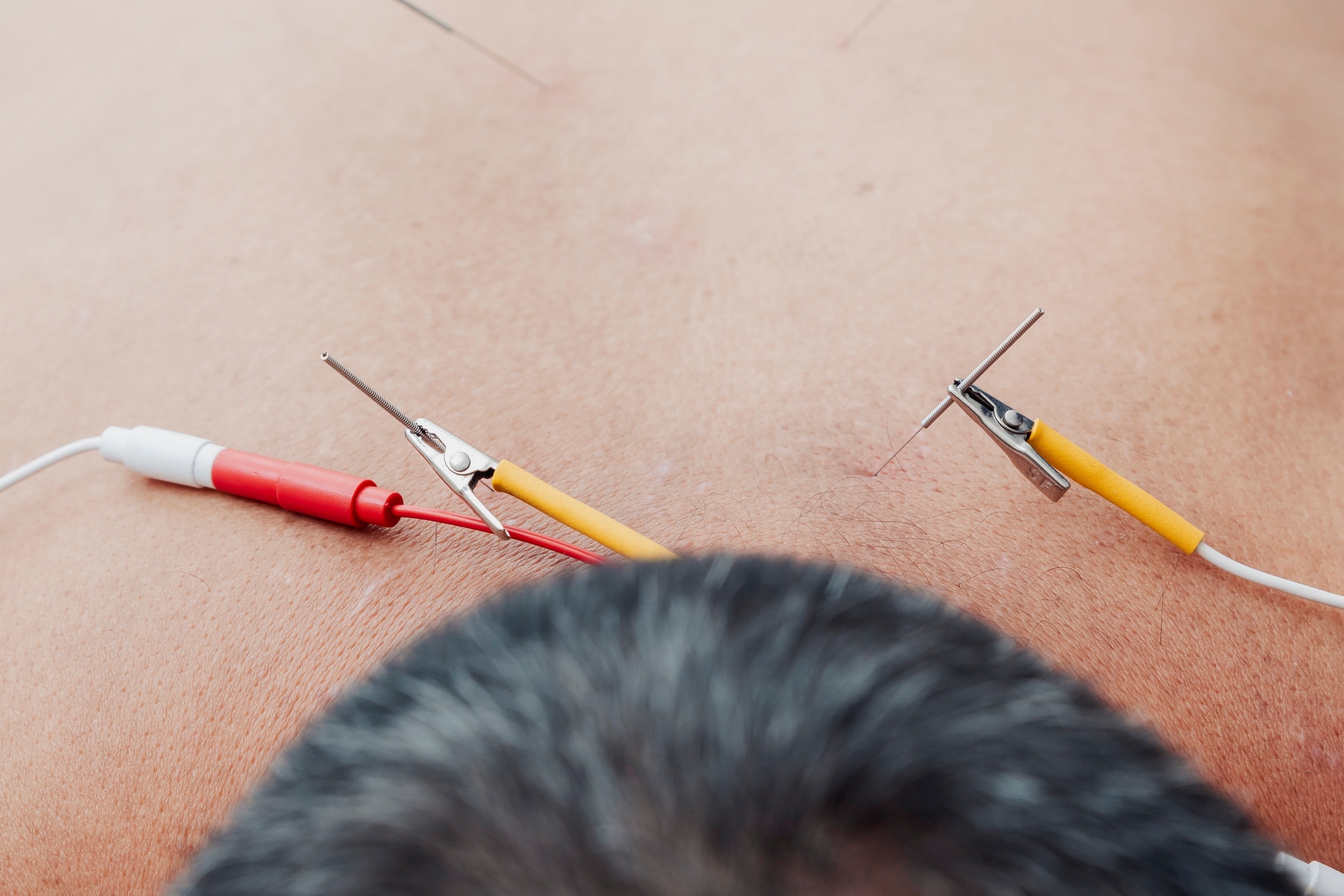
Dry needling releases the neck and jaw trigger points that refer pain to your head. Alongside dry needling, I use neuro-functional acupuncture, built on neuroscience and evidence-based practice. Unlike regular electroacupuncture, the needles and gentle electrical stimulation are mapped to the specific nerves involved, such as the nerves of the neck. It works in three ways. It neurorehabilitates, helping irritated tissues and nerve receptors recover. It neuromodulates, shifting the body's own pain-relieving chemistry. It neuroregulates, calming the nerve signals and circuits that keep neck tension and headaches going. You also get workstation guidance, coordinated with your physician, physical therapist or neurologist. Most patients are seen weekly or every other week during active care, and results vary from person to person.
See a doctor first if you have a sudden, severe headache, the worst of your life; a headache with fever and a stiff neck; a headache after a head injury; new weakness, numbness, confusion, vision loss or trouble speaking; a new headache pattern after age 50; or a headache that wakes you or steadily worsens over days or weeks. These need prompt medical evaluation. The sudden worst headache, a headache with fever and a stiff neck, and any headache with new weakness, confusion or vision loss need emergency care right away.
If you are not sure what is causing your pain, try the My Symptoms tool.
Questions people ask
Can looking down at my phone really cause headaches?
It can add to them. The NIH lists staring at a phone screen among the postures that can trigger tension-type headaches. Bring the phone up and take regular breaks.
Is a standing desk better for my neck?
Standing helps most as a way to change position, not as a posture to hold all day. The same setup rules apply, and NIH guidance suggests alternating between sitting and standing.
Why are my headaches worse on busy, stressful days?
Under stress, many people raise their shoulders and clench their jaw without noticing, and those muscles stay tense for hours. Stress and poor sleep also lower the headache threshold. Short breaks to drop your shoulders and unclench can help.
References
- National Institute of Neurological Disorders and Stroke. Headache. National Institutes of Health. https://www.ninds.nih.gov/health-information/disorders/headache
- Alonso-Blanco C, et al. Prevalence and anatomical localization of muscle referred pain from active trigger points in head and neck musculature in adults and children with chronic tension-type headache. Pain Med. 2011;12(10):1453-1463.
- Al Khalili Y, et al. Cervicogenic headache. StatPearls. Treasure Island (FL): StatPearls Publishing; updated 2022.
- Jun D, et al. Physical risk factors for developing non-specific neck pain in office workers: a systematic review and meta-analysis. Int Arch Occup Environ Health. 2017;90(5):373-410.
- National Institutes of Health, Office of Research Services. Ergonomics: prevention. https://ors.od.nih.gov/sr/dohs/HealthAndWellness/Ergonomics/Pages/prevention.aspx