Electroacupuncture Explained: What the Gentle Current Does
Around 45 AD, Scribonius Largus, physician to the Roman emperor Claudius, recommended placing a live electric ray, the torpedo fish, on the head for headaches and under the feet for gout. It is not a big leap from there to carrying a gentle current through the needle. That is electroacupuncture: a mild, pulsing current sent through fine acupuncture needles to strengthen their effect on irritated muscles and nerves.
Learn moreHow Dr. Gordon uses acupuncture and electroacupunctureWhat electroacupuncture is
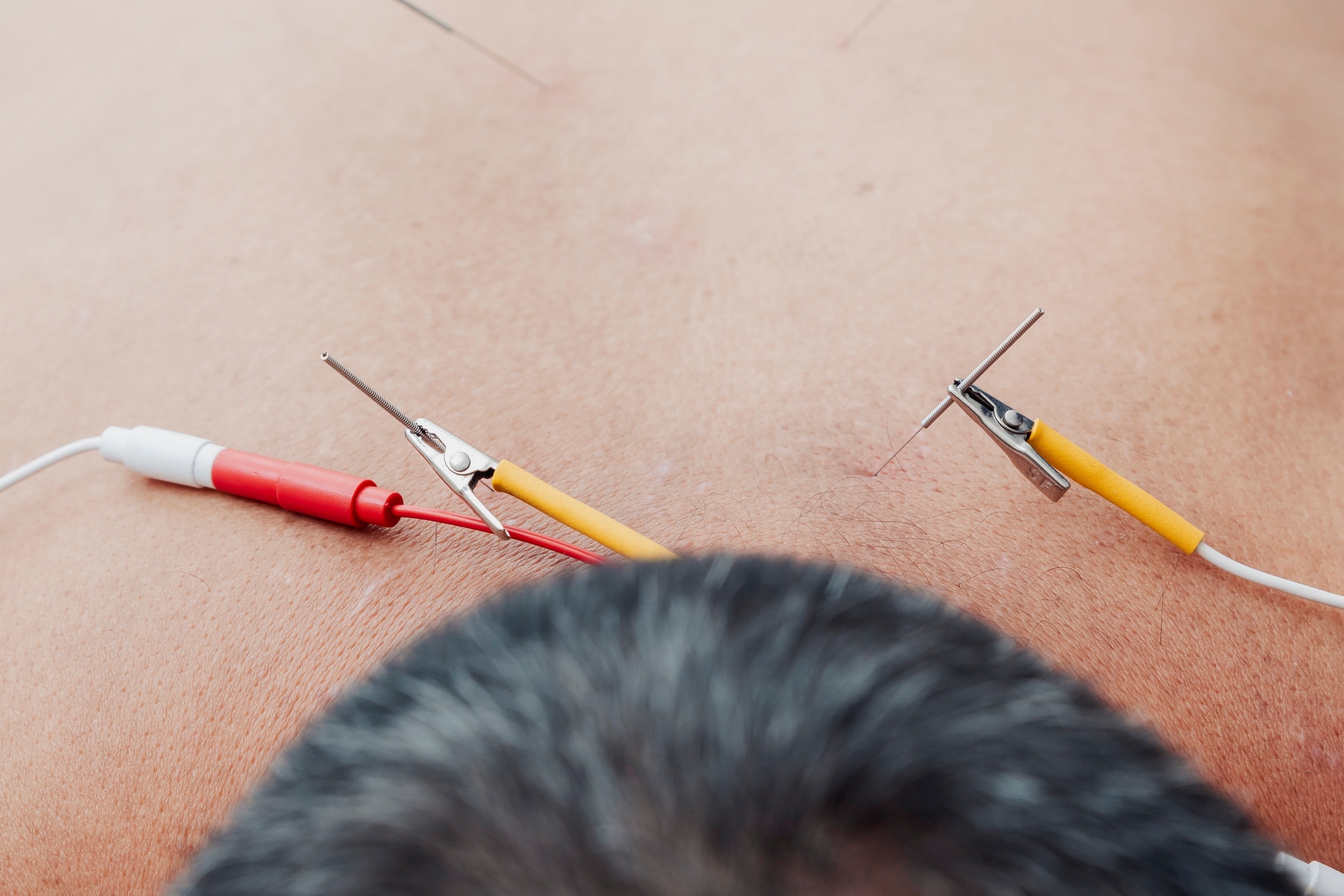
The needles are the same very fine, solid needles used in acupuncture and dry needling. I place them first, by hand. Then small leads connect pairs of needles to a stimulator, which sends a gentle, pulsing current between them.
Traditionally, acupuncturists strengthen the effect of a needle by turning it or moving it by hand. The current does a similar job, steadily, for the length of the treatment.
What the current does
In my North New Hyde Park clinic, electroacupuncture works mostly along nerve pathways. For sciatica, I run it along the lumbar and sciatic nerve pathways to calm nerve irritation. After a C-section, it can calm irritated nerves near the scar and ease burning and sensitivity, as my post-cesarean scar pain page explains. For neck and back pain, the same approach runs along the cervical and lumbar nerve pathways.
It pairs naturally with neuro-functional acupuncture, which is built on neuroscience and evidence-based practice. It is different from regular electroacupuncture, because the needles and gentle electrical stimulation are mapped by nerve, plexus and spinal segment to the specific nerves involved. It works in three ways. It neurorehabilitates, helping irritated tissues and nerve receptors recover. It neuromodulates, shifting the body's own pain-relieving chemistry. It neuroregulates, calming a nervous system that has turned the volume up on pain. I explain how this fits with dry needling in Dry Needling vs Acupuncture.
As for what happens inside the body, a 2014 review in the journal Anesthesiology gathered the laboratory research on electroacupuncture and persistent pain. It found that the current blocks pain by triggering a range of the body's own chemicals at three levels: the nerves near the needles, the spinal cord and the brain. These include natural opioids, along with serotonin and norepinephrine, which help quiet pain signals in the spinal cord. In those studies, lower frequencies (2 to 10 Hz) eased inflammatory and nerve pain more than a high frequency (100 Hz).
Most of that work was done in animals. It explains how the current may work more than it predicts how any one person will respond. Results vary from person to person.
What it feels like
Most people feel a light tapping, pulsing or buzzing around the needles. Sometimes the muscle twitches gently in time with the current. I start the current low and turn it up slowly, until you can clearly feel it but it stays comfortable. It should never feel sharp. If it feels too strong, tell me and I turn it down right away.
Many people find it relaxing and rest quietly while the current runs.
Who it suits
Electroacupuncture tends to fit when nerves are part of the pain:
- Sciatica, or pain that travels along a nerve from the back or neck.
- Long-standing pain where the nervous system has become sensitized, so the pain feels bigger than the injury.
- Burning, numbness or hypersensitivity around a scar, such as after a C-section.
I add it when it helps, often in the same visit as dry needling. Not everyone needs it. When tight muscles are the main problem, dry needling on its own may be enough.
Tell me first if you have a pacemaker or another implanted electrical device, or if you are pregnant. In those cases I may leave the current off and use the needles alone.
If you are not sure what is causing your pain, try the My Symptoms tool.
Questions people ask
Will the current give me a shock?
No. The current is gentle and set to your comfort. You feel a steady tapping or buzzing, not a jolt, and I can turn it down at any moment.
Is electroacupuncture the same as a TENS unit?
They are related. Both use a mild electrical current to calm pain. A TENS unit sends it through pads on the skin. Electroacupuncture carries it through the needle, straight to the muscle or nerve being treated.
Do I need electroacupuncture at every visit?
Not always. I add it when nerve irritation or sensitivity is part of the picture, and leave it out when the needles alone are enough. The plan can change as you improve.
References
- Tsoucalas G, et al. The "torpedo" effect in medicine. Int Marit Health. 2014;65(2):65-67.
- Sarmiento CI, et al. Brief history of transcranial direct current stimulation (tDCS): from electric fishes to microcontrollers. Psychol Med. 2016;46(15):3259-3261.
- Zhang R, et al. Mechanisms of acupuncture-electroacupuncture on persistent pain. Anesthesiology. 2014;120(2):482-503.
- National Center for Complementary and Integrative Health. Acupuncture: effectiveness and safety. Updated October 2022.