
Regenerative Sound Wave Therapy
Shockwave Therapy in North New Hyde Park
Regenerative sound wave therapy that starts by finding exactly where your problem is. Focused shockwave is Dr. Gordon's primary treatment, with piezo and radial available when your tissue calls for them.
Consider this an invitation to meet Dr. Gordon and experience true 1 on 1 care. Your introductory visit includes a shockwave mapping session and initial treatment of one area.
Introductory Visit
Shockwave mapping session plus initial treatment of one area
What Is Shockwave Therapy?
Shockwave therapy (also called extracorporeal shockwave therapy, or ESWT) uses a special acoustic sound wave that travels very fast through your tissue. It does not damage tissue. Instead, it gently mimics an injury, which signals your body to send a healing response right to the area that needs it. No needles, no incisions and no medication.
Here is what shockwave does:
- 1
Breaks down old, damaged tissue. It helps clear out old and damaged tissue, such as scar tissue, that keeps an area from healing.
- 2
Increases blood flow. It drives circulation into the treated area, bringing the nutrients your tissue needs to heal.
- 3
Calms chronic inflammation. It helps turn long-standing, stuck inflammation into an active healing response.
- 4
Activates your body's own repair cells. Research suggests shockwave can recruit and activate the body's own repair cells, including stem cells, over the weeks and months after treatment. This is why shockwave is often called regenerative therapy.
The first three effects start right away. The fourth builds over time, which is why shockwave is a process and not a one-visit fix.
Conditions Dr. Gordon Treats with Shockwave Therapy
Trigger points and myofascial pain in the neck, shoulders, back, hips and legs
Scar tissue and adhesions, including post-surgical and C-section scar pain
Arthritis, including knee and hip osteoarthritis
Tendonitis and tendinopathy, including tennis and golfer's elbow, rotator cuff and shoulder pain, Achilles and patellar tendon pain
Plantar fasciitis and heel pain
Back pain and neck pain with a muscular or trigger point component
Not sure if shockwave is right for your condition? Contact the clinic and Dr. Gordon will let you know.
The Mapping Session: Your Body Shows Dr. Gordon Where the Problem Is
Before he treats, he maps the area to find exactly where the damaged tissue is.
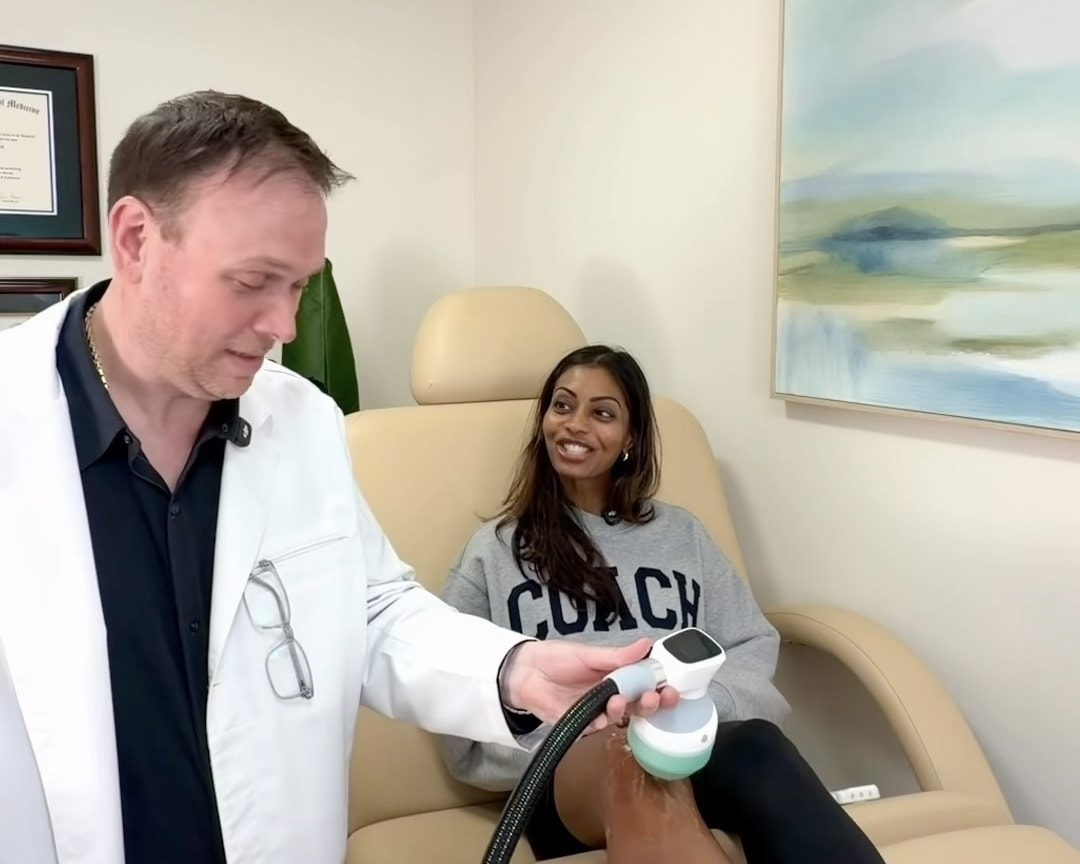
He slowly moves the shockwave applicator across the region and lets your body tell him where the problem is. Over healthy tissue, you feel almost nothing. Over damaged tissue, such as a trigger point, scar tissue adhesion, irritated tendon or arthritic joint, you will feel it: a deep, familiar ache that says "that's the spot." You can actually feel that the problem has been found and is being treated.
What to expect during mapping:
Tolerable, not painful. On a scale of 0 to 10, Dr. Gordon aims for a 4, 5 or 6, never close to a 10.
You guide Dr. Gordon. You call out the number you feel in each spot. Your feedback is how he pinpoints the damaged tissue and decides where to focus.
It shapes your whole plan. Mapping shows Dr. Gordon the size of the problem area and the state of the tissue, so your treatment recommendations are based on what he actually finds.
Researchers are now studying focused shockwave as a tool for locating trigger points, and it is a big part of what makes treatment so precise.
Are You a Good Candidate?
Two things make someone a strong candidate for shockwave:
Dr. Gordon finds damaged tissue during mapping. Healthy tissue feels like nothing. Damaged tissue is something you can feel, and that is how he knows where to treat.
The joint has space to work with. A joint that is fully "bone on bone" leaves little room for new tissue to form. Mapping helps Dr. Gordon understand the state of the joint so he can tell you honestly whether shockwave makes sense.
The 3 Types of Shockwave Therapy (And Why It Matters)
Not all "shockwave" is the same. The word is used for three very different technologies, and Dr. Anthony Gordon Acupuncture has all three. Focused shockwave is Dr. Gordon's primary treatment, and having piezo and radial as well means he can match the treatment to where your problem actually is, whether it sits just under the skin or several centimeters deep in a tendon, joint or muscle.
1. Radial Shockwave (Radial Pressure Waves)
Radial devices use a projectile inside the handpiece to create a pressure wave that spreads outward from the tip. The energy is strongest at the skin and gets weaker the deeper it travels. Technically, radial waves are pressure waves, not true shockwaves. Radial is useful for broad, superficial areas and tight muscles, and it is the type most commonly found in gyms, chiropractic offices and physical therapy clinics because the equipment costs less.
2. Focused Shockwave (Electromagnetic)
Focused shockwave produces a true shockwave and concentrates the energy at a chosen depth below the skin, like sunlight through a magnifying glass. Instead of fading as it goes deeper, the energy peaks at the target. This allows Dr. Gordon to reach deep tendon attachments, joints and trigger points that radial energy cannot reach at full strength. This is why focused shockwave is the primary treatment in the clinic.
3. Piezoelectric Shockwave (Piezo)
Piezo shockwave is a type of focused shockwave generated by hundreds of crystals that fire at the same moment toward one small focal point. It is extremely precise, the treatment depth can be adjusted, and many patients find it comfortable. It is ideal for pinpointing small, specific problem areas.
| Radial | Focused | Piezo | |
|---|---|---|---|
| Where the energy peaks | At the skin | At a set depth | At a precise, adjustable point |
| Best for | Broad, superficial muscle areas | Deep tendons, joints and trigger points | Small, exact targets |
| True shockwave? | No (pressure wave) | Yes | Yes |
Further Reading
Focused vs Radial Shockwave: Which One Does Your Injury Need?
From the blog: which type of shockwave reaches your injury, and four questions to ask before you book.
Golf, Tennis and Elbow Pain That Will Not Settle
From the blog: Tennis and golfer's elbow often linger because they are a tendon load problem, not simple inflammation. How grip, swing and daily tasks keep them going.
Tried Shockwave Before and It Didn't Help?
Dr. Gordon often meets patients who say they already tried shockwave and it did nothing. In many of these cases, they only received radial treatment. If the source of the pain is a deep tendon insertion, a hip or gluteal trigger point, or scar tissue several layers down, radial energy may simply fade out before it gets there.
Other common reasons include treating the spot that hurts instead of the spot causing the pain, skipping the mapping step, and not addressing the surrounding muscles and fascia. Because he maps first and has all three technologies, he chooses the right one (or combination) for your specific tissue and depth instead of using one machine for everything.
What to Expect After Treatment
Everyone responds a little differently after a session. Some people feel lighter and move more easily, some feel sore for a day or so, and some do not notice a change right away. What patients consistently tell Dr. Gordon is that during treatment, they can really feel the problem being found and worked on.
Keep in mind that nothing is fully fixed after one visit. The healing response ramps up over the next day or two and then settles, and the regenerative effects build over the following weeks and months. If you do feel sore, it is a sign your body is responding. Dr. Gordon will give you simple aftercare instructions at your visit. After your mapping, Dr. Gordon reviews the findings with you and recommends a plan, including how many sessions your case needs. Results vary from person to person, and he screens for safety before your first treatment.
Shockwave on Acupressure Points and Trigger Points
Acupressure uses finger pressure on specific points. Shockwave can stimulate the same acupuncture points and myofascial trigger points with a much stronger, deeper and more precise stimulus, without a single needle. Researchers have described this as a form of needle-free acupuncture, and shockwave has been studied as a treatment for myofascial trigger point pain.
For patients who are nervous about needles, this can be a great way to get the benefits of point-based treatment.
Even Better: Combining Shockwave with Acupuncture or Dry Needling
For many conditions, shockwave works best as part of a plan rather than on its own. Dr. Gordon can combine shockwave with acupuncture or functional dry needling in the same treatment plan, so each tool does what it does best.
The research supports this approach. In a randomized trial of 90 patients with myofascial pain syndrome, the group that received shockwave combined with electroacupuncture had better results than the groups that received either treatment alone.
Shockwave Therapy FAQs
- What does the $49 new patient visit include?
- Your $49 visit includes a full shockwave mapping session to locate the damaged tissue, plus an initial shockwave treatment of one area. Dr. Gordon will then review what the mapping showed and recommend a plan.
- What is a shockwave mapping session?
- Mapping is how Dr. Gordon finds the damaged tissue before treating. He moves the applicator across the area, and you tell him what you feel. Healthy tissue feels like almost nothing, while damaged tissue is clearly noticeable. This tells him exactly where to focus.
- Does shockwave therapy hurt?
- It should be tolerable, not painful. Dr. Gordon aims for about a 4 to 6 out of 10 over the problem areas, and he adjusts the intensity as he goes based on your feedback.
- Is focused shockwave better than radial shockwave?
- They do different jobs. Radial is best for broad, superficial areas. Focused and piezo shockwave deliver their energy at depth, so they are better suited to deep tendons, joints and trigger points. Having all three lets Dr. Gordon use the right one for your problem.
- I already tried shockwave and it didn't help. Should I try again?
- Possibly. If your previous treatment was radial only, or was done without mapping, the energy may not have reached the source of your pain. Dr. Gordon will review what you had before and explain whether focused or piezo treatment makes sense for you.
- Can shockwave be combined with acupuncture or dry needling?
- Yes. Combining shockwave with acupuncture or dry needling is a core part of how Dr. Gordon treats chronic and complex pain.
- How many sessions will I need?
- It depends on what is found during mapping, the size of the area and the state of the tissue. You will get a specific recommendation when Dr. Gordon reviews your findings with you.
Start with Shockwave Therapy in North New Hyde Park
Your first step is an introductory mapping session with Dr. Gordon, plus an initial treatment of one area, for $49. He will find exactly where your damaged tissue is, treat your first spot, and show you what your body needs. This introductory visit is shockwave only and does not include acupuncture, dry needling, massage or separate acupressure.
Dr. Anthony Gordon Acupuncture
1508 Union Turnpike, Suite 133, North New Hyde Park, NY 11040
(516) 597-5400
Serving Nassau County and Long Island's North Shore.