Focused vs Radial Shockwave: Which One Does Your Injury Need?
It depends on how deep the problem sits. Radial shockwave is strongest at the skin and fades with depth, so it suits broad, surface-level muscle tension. Focused shockwave concentrates its energy at a set depth, so it can reach deep tendon attachments, joints and trigger points. For most heel, elbow, shoulder and knee problems, the target is deep enough that focused shockwave is the better fit.
Learn moreFocused shockwave therapy at Dr. Gordon AcupunctureFocused vs radial shockwave: the difference is depth
Radial devices send a pressure wave that spreads out from the tip, so the energy is highest at the skin and weaker below it. Focused devices create a true shockwave that peaks at the chosen target, several centimeters deep if needed. Piezo shockwave is a type of focused shockwave that aims at a very small, precise point. The shockwave therapy page compares all three side by side.
Radial units are common in gyms, chiropractic offices and physical therapy clinics, partly because the equipment costs less. That is worth knowing if you have tried shockwave before.
A guide by injury
This is a general guide. The mapping session, described below, makes the final call.
- Plantar fasciitis and heel pain. The problem usually sits where the fascia attaches to the heel bone, under the thick heel pad. Focused shockwave can be aimed at that attachment.
- Tennis and golfer's elbow. The damaged tendon area is small and specific, so focused or piezo shockwave lets the energy land exactly where it is needed.
- Rotator cuff and shoulder pain. These tendons sit underneath the shoulder muscle, which puts them in focused territory.
- Achilles and patellar tendon pain. Focused shockwave treats the tendon itself. Radial can help the tight calf or thigh muscles around it.
- Knee and hip osteoarthritis. The joint is deep, so focused shockwave is the tool. Mapping also checks that the joint still has enough space for new tissue.
- Broad muscle tightness in the back, thighs or calves. Radial covers large surface areas well. Focused is still useful for specific deep trigger points within those muscles.
How mapping decides
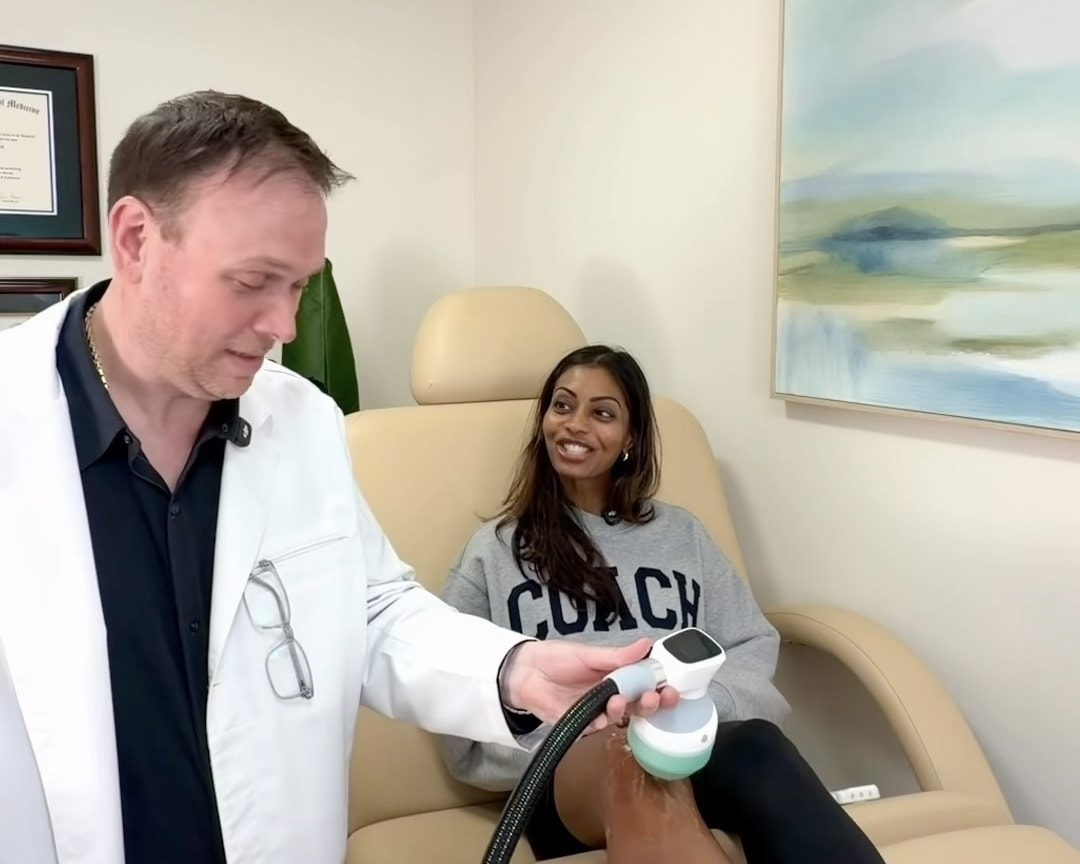
Before treatment, I move the applicator slowly across the area while you tell me what you feel. Healthy tissue feels like almost nothing. Damaged tissue gives a deep, familiar ache. You rate each spot from 0 to 10, and I aim for about 4 to 6, never near 10.
That map shows where the damaged tissue is, how large the area is, and whether shockwave makes sense at all. Damaged tissue has to show up on mapping for treatment to be worth doing.
Four questions to ask before you book shockwave anywhere
- Is the device focused or radial?
- Will you map the area before treating it?
- How will you decide how many sessions I need?
- If part of my pain comes from nerves or tight muscles, how will you treat that part?
The last question matters more than people expect. Shockwave works on damaged tissue, the hardware. When nerves are also sensitized, pairing it with dry needling or acupuncture often gives a better result. In one randomized trial of 90 people with myofascial pain, shockwave plus electroacupuncture worked better than either one alone (reference 1).
Questions people ask
Is radial shockwave useless?
No. It is a good tool for broad, surface-level muscle tension, and I use it when an area calls for it. It just cannot deliver much energy to a deep tendon or joint.
I was told my knee is bone on bone. Can shockwave still help?
It depends on what mapping shows. A joint needs some space for new tissue to form, and a fully bone on bone joint leaves very little. Mapping tells me whether shockwave is a reasonable option before you commit to a plan.
How soon will I notice a difference?
It varies. Some people feel lighter right after a session, some feel sore for a day or so, and some notice no change at first. The healing response builds over a day or two, and the repair effects continue over the following weeks to months.
References
- Fang H, Xiong C, Mu JP. Clinical study on extracorporeal shock wave therapy plus electroacupuncture for myofascial pain syndrome. Journal of Acupuncture and Tuina Science. 2014;12(1):55-59.